
Tuesday, 27 August 2019


Wednesday, 21 August 2019
Baisakhi, Vaishakhi, or Vasakhi 🤗👍💫💭🎓 testing
Vaisakhi (IAST: visākhī), also known as Baisakhi, Vaishakhi, or Vasakhi is a historical and religious festival in Hinduism and Sikhism. It is usually celebrated on 13 or 14 April every year,[4][5][6] which commemorates the formation of Khalsa panth of warriors under Guru Gobind Singh in 1699.[1][2][7][8]
In Hinduism, Vaisakhi celebrates the Solar new year, based on the Vikram Samvat calendar. Vaisakhi marks the first day of the month of Vaisakha. It is additionally a spring harvest festival for Hinduism and Sikhs.[7]
In Sikhism, Vaisakhi marks the start of the Khalsa. This was in 1699 that the Khalsa was created so this is the beginning of the Khalsa.
Vaisakhi observes major events in the history of Sikhism and the Indian subcontinent that happened in the Punjab region.[9][10] The significance of Vaisakhi as a major Sikh festival marking the birth of Sikh order started after the persecution and execution of Guru Tegh Bahadur for refusing to convert to Islam under the orders of the Mughal Emperor Aurangzeb. This triggered the coronation of the tenth Guru of Sikhism and the historic formation of Khalsa, both on the Vaisakhi day.[11][12][13] Vaisakhi was also the day when colonial British empire officials committed the Jallianwala Bagh massacre on a gathering, an event influential to the Indian movement against colonial rule.[9]
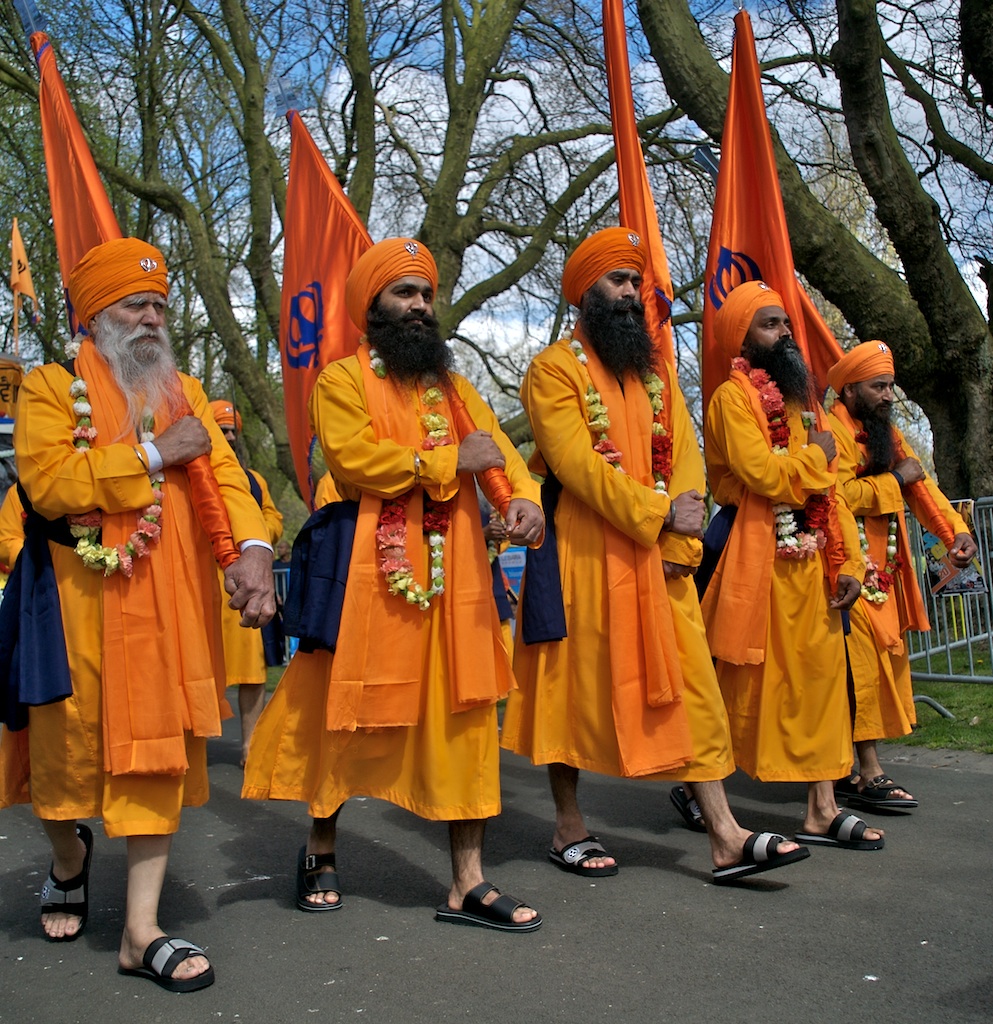
On Vaisakhi, Gurdwaras are decorated and hold kirtans, Sikhs visit and bathe in lakes or rivers before visiting local Gurdwaras, community fairs and nagar kirtan processions are held, and people gather to socialize and share festive foods.[5][9][14]
For many Hindus, the festival is their traditional solar new year, a harvest festival, an occasion to bathe in sacred rivers such as Ganges, Jhelum, and Kaveri, visit temples, meet friends and take part in other festivities. In other parts of India, the Vaisakhi festival is known by various regional names.[15
History[edit]
Since the time of Guru Amar Das it has been customary for Sikhs to assemble before their Guru on three of the most important Hindu festival occasions – Vaisakhi, Divali, and Maha Shivaratri. The alternative view is that Guru Amar Das chose Maghi, instead of Maha Shivaratri.[20][21]
Subsequent events gave a new meaning to the festival which is, in part, a remembrance of the foundation of the Khalsa Sikh order which started after the ninth Guru Tegh Bahadur was persecuted and then beheaded under the orders of the Mughal Emperor Aurangzeb, after he stood up for freedom of religious practice and refused to convert to Islam.[11][12] The guru's martyrdom triggered the coronation of the tenth and last Guru of Sikhism, and the formation of the sant-sipahi group of Khalsa,[22][23] both on the Vaisakhi day.[12]
The Vaisakhi festival Khalsa tradition started in the year 1699,[9] as it is on this day that the 10th Guru of the Sikhs, Guru Gobind Singh laid down the foundation of the Panth Khalsa, that is the Order of the Pure Ones, by baptizing Sikh warriors to defend religious freedoms.[24][25][26] This gave rise to the Vaisakhi or Baisakhi festival being observed as a celebration of Khalsa panth formation and is also known as Khalsa Sirjana Divas[27] and Khalsa Sajna Divas.[28] The festival is celebrated on Vaisakhi day (typically 14 April), since 1699. The Birth of the Khalsa Panth was either on 13 April 1699[29] or 30 March 1699.[30] Since 2003, the Sikh Gurdwara Prabhandak Committee named it Baisakh (Vaisakh), making the first day of the second month of Vaisakh according to its new Nanakshahi calendar.[31]
A special celebration takes place at Talwandi Sabo (where Guru Gobind Singh stayed for nine months and completed the recompilation of the Guru Granth Sahib),[32] in the Gurudwara at Anandpur Sahib the birthplace of the Khalsa, and at the Golden Temple in Amritsar.
Sikh New Year[edit]
According to the Khalsa sambat, the Khalsa calendar starts with the creation of the Khalsa which is 1 Vaisakh 1756 Bikrami (30 March 1699).[33][34] Accordingly, Vaisakhi has been the traditional Sikh New Year.[1][2][35] The festival has been traditionally observed in the Punjab region.[36][37] The alternative Nanakshahi calendar begins its year a month earlier on 1 Chait which generally falls on 14 March and begins with the birth year of the Guru Nanak Dev in 1469.[38]
Nagar Kirtan[edit]
Sikhs communities organise processions called nagar kirtan (literally, "town hymn singing"). These are led by five khalsa who are dressed up as Panj Pyaare, and the processions through the streets. The people who march sing, make music, sing hymns from the Sikh texts. Major processions also carry a copy of the Guru Granth Sahib in reverence.[7]
 bold italics underlined
Monday, 19 August 2019
Sunday, 18 August 2019
Wednesday, 14 August 2019
Tuesday, 13 August 2019
Subscribe to:
Comments (Atom)